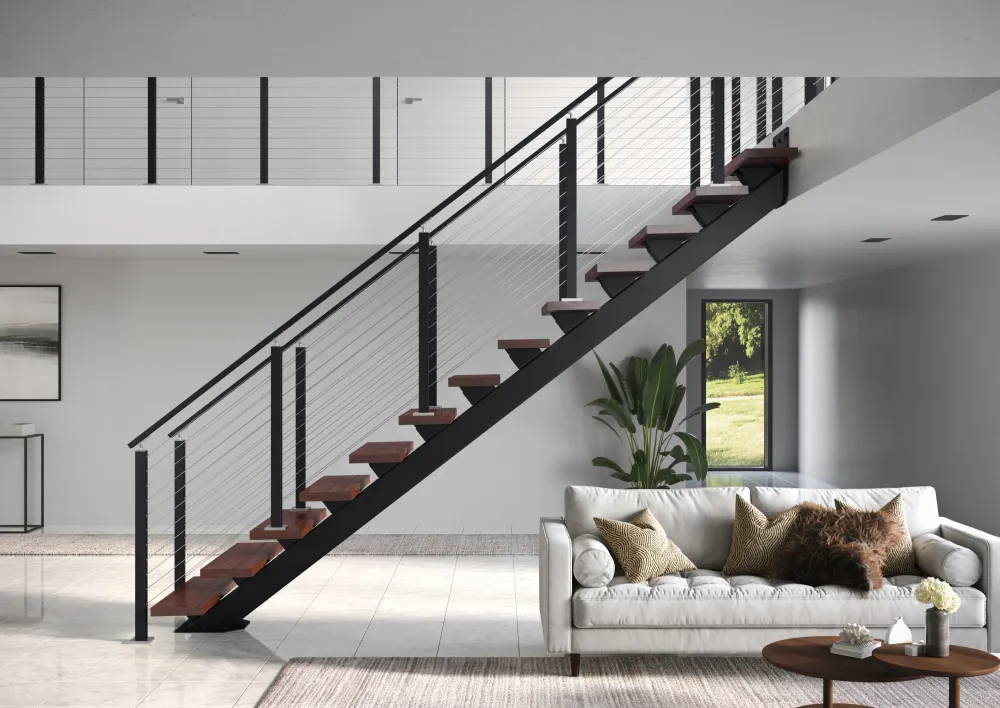
Integrated LED Stair Lighting for Virginia Luxury Homes
Lighting transforms a staircase from a functional structure into a living architectural feature. The right lighting system does not just illuminate your steps. It creates depth, defines edges, and adds a layer of sophistication that no other single element can match.
Why Integrated Lighting Is a Structural Decision
Most homeowners think of stair lighting as a finishing touch. In reality, it is an engineering decision that needs to happen early in the design process. LED channels need to be recessed into tread nosings, stringer profiles, or riser faces during fabrication. Once the steel is welded and the treads are installed, adding proper integrated lighting becomes far more complex and far more expensive.
Because of this, we plan every lighting detail during the 3D BIM modeling phase, alongside the structural components. This approach means your lighting sits flush with the staircase surface. There are no visible wires, no surface-mounted housings, and no visible hardware. The light appears to emerge from within the structure itself, which is exactly the effect luxury homeowners are looking for.
Smart Home Integration
Virginia''''s luxury residential market increasingly centers around whole-home automation. Homeowners across the state are investing in systems like Lutron, Savant, and Control4 to manage lighting, climate, security, and entertainment from a single interface. Our LED stair lighting systems are fully compatible with these platforms.
Motion-sensor activation can be programmed so your staircase lights gradually as you approach and fades once you pass. Brightness levels can be adjusted by time of day, tied to sunrise and sunset schedules, or controlled through voice commands via Alexa or Google Home integration.
For homes with Lutron Homeworks or Savant Pro installations, our lighting circuits are wired to integrate directly with your existing control panels. There is no need for a separate app or a separate system. Your staircase lighting becomes one more element inside the home automation environment you already use. This level of integration also aligns with Aging-in-Place design principles. Automatic, motion-activated lighting on a staircase removes one of the most common household fall risks without requiring any manual interaction from the user.
Lighting Design Options
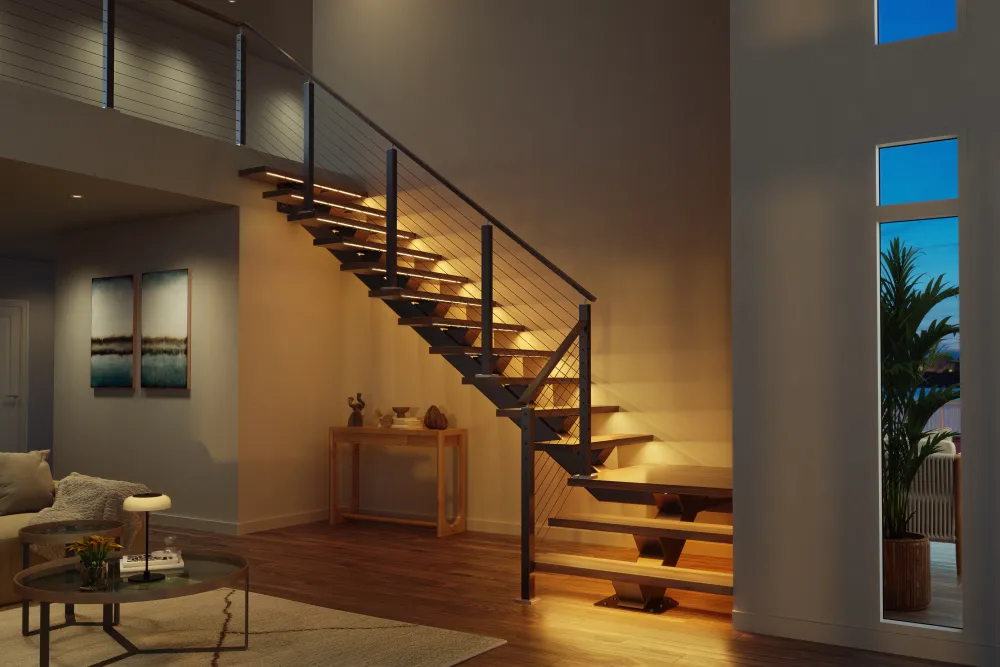
Every home calls for a different lighting approach, and we design accordingly. Tread-edge lighting places a thin line of light along the front nose of each step. This is the most popular choice for contemporary floating stair designs because it emphasizes the horizontal geometry of the staircase and makes each tread clearly visible from any angle.
Stringer-face lighting runs a continuous light channel along the side profile of the structural stringer. This approach creates a dramatic floating effect, especially in open-plan spaces where the staircase is visible from multiple rooms. Riser lighting is recessed into the vertical face of each step and casts light downward onto the tread below. It produces a warm, layered effect that works particularly well in transitional and traditional interior styles.
Combinations of these approaches are common in larger staircases, where a single lighting type may not fully honor the scale of the structure.
Technical Standards and Safety
All LED systems we install are specified at a minimum of IP44 rating for moisture resistance, which matters in homes where climate control creates condensation variance between floors. Driver units are concealed within the stringer profile or within adjacent wall cavities and are fully accessible for maintenance without disturbing the staircase structure.
Wiring runs are compliant with Virginia Uniform Statewide Building Code and are coordinated with your licensed electrician during the installation phase. Our structural standards are set by the master fabricators at Capitol Iron Works, ensuring every Virginia installation meets industrial safety grades from the steel frame to the final lighting circuit.
Color temperature options range from 2700K for warm ambient tones to 4000K for crisp, gallery-style illumination. Tunable white systems, which shift color temperature throughout the day, are also available for homes using circadian lighting schedules.
A Staircase That Works Around the Clock
A staircase that disappears into shadow at night is a missed opportunity. One that glows with purpose is an architectural statement that works around the clock. Your staircase should be just as striking at midnight as it is at noon.